
$A$ cell having an emf $\varepsilon$ and internal resistance $r$ is connected across a variable external resistance $R$. As the resistance $R$ is increased,the plot of potential difference $V$ across $R$ is given by:
- A
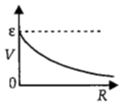
- B
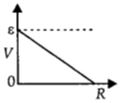
- C
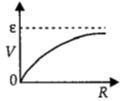
- D
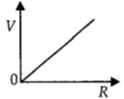
Explore More
Similar Questions
The thermoelectric electromotive force $e$ is given by $e = \alpha t - \frac{1}{2}\beta t^2$. If the temperature of the cold junction is $0 \, ^\circ C$,find the temperature of inversion $t_i$. (Given: $\alpha = 500.0 \, \mu V/^\circ C$,$\beta = 5.0 \, \mu V/^\circ C^2$)
Difficult
View SolutionIn the circuit shown here,$E_1 = E_2 = E_3 = 2 \, V$ and $R_1 = R_2 = 4 \, \Omega$. The current flowing between points $A$ and $B$ through battery $E_2$ is
Medium
View SolutionAt time $t = 0$,terminal $A$ in the circuit shown in the figure is connected to $B$ by a key and alternating current $I(t) = I_0 \cos(\omega t)$,with $I_0 = 1 \text{ A}$ and $\omega = 500 \text{ rad s}^{-1}$ starts flowing in it with the initial direction shown in the figure.
At $t = \frac{7\pi}{6\omega}$,the key is switched from $B$ to $D$. Now onwards only $A$ and $D$ are connected. $A$ total charge $Q$ flows from the battery to charge the capacitor fully. If $C = 20 \mu\text{F}$,$R = 10 \Omega$ and the battery is ideal with emf of $50 \text{ V}$,identify the correct statement$(s)$.
$(A)$ Magnitude of the maximum charge on the capacitor before $t = \frac{7\pi}{6\omega}$ is $1 \times 10^{-3} \text{ C}$.
$(B)$ The current in the left part of the circuit just before $t = \frac{7\pi}{6\omega}$ is clockwise.
$(C)$ Immediately after $A$ is connected to $D$,the current in $R$ is $10 \text{ A}$.
$(D)$ $Q = 2 \times 10^{-3} \text{ C}$.
At $t = \frac{7\pi}{6\omega}$,the key is switched from $B$ to $D$. Now onwards only $A$ and $D$ are connected. $A$ total charge $Q$ flows from the battery to charge the capacitor fully. If $C = 20 \mu\text{F}$,$R = 10 \Omega$ and the battery is ideal with emf of $50 \text{ V}$,identify the correct statement$(s)$.
$(A)$ Magnitude of the maximum charge on the capacitor before $t = \frac{7\pi}{6\omega}$ is $1 \times 10^{-3} \text{ C}$.
$(B)$ The current in the left part of the circuit just before $t = \frac{7\pi}{6\omega}$ is clockwise.
$(C)$ Immediately after $A$ is connected to $D$,the current in $R$ is $10 \text{ A}$.
$(D)$ $Q = 2 \times 10^{-3} \text{ C}$.
The thermo emf of a thermocouple is given by $E = aT + bT^2$,where $\frac{a}{b} = -200^{\circ}C$. If the cold junction is kept at $30^{\circ}C$,then the inversion temperature is ($\varepsilon$ in volt,$T$ in centigrade). (in $K$)
DifficultTS EAMCET 2010
View SolutionThe thermo-emf of a hypothetical thermocouple varies with the temperature $\theta$ of the hot junction as $E = a\theta + b\theta^2$ in volts,where the ratio $a/b$ is $700^{\circ}C$. If the cold junction is kept at $0^{\circ}C$,then the neutral temperature is:
DifficultAP EAMCET 2011
View SolutionVedclass Products
For Students
Vedclass Test Series
Mock tests in real JEE/NEET style with performance analysis. 5-day free trial.
Start Free TrialFor Teachers
Exam Paper Generator
Generate Set A/B/C/D exam papers from 7.5L+ questions in 2 minutes. 3 chapters free.
Try FreeFor Institutes
Online Exam Module
Live online exams with unlimited students, 360° analytics & white-label branding.
See Demo